
Inclusion, governance and supervision: professional judgement (2/6)
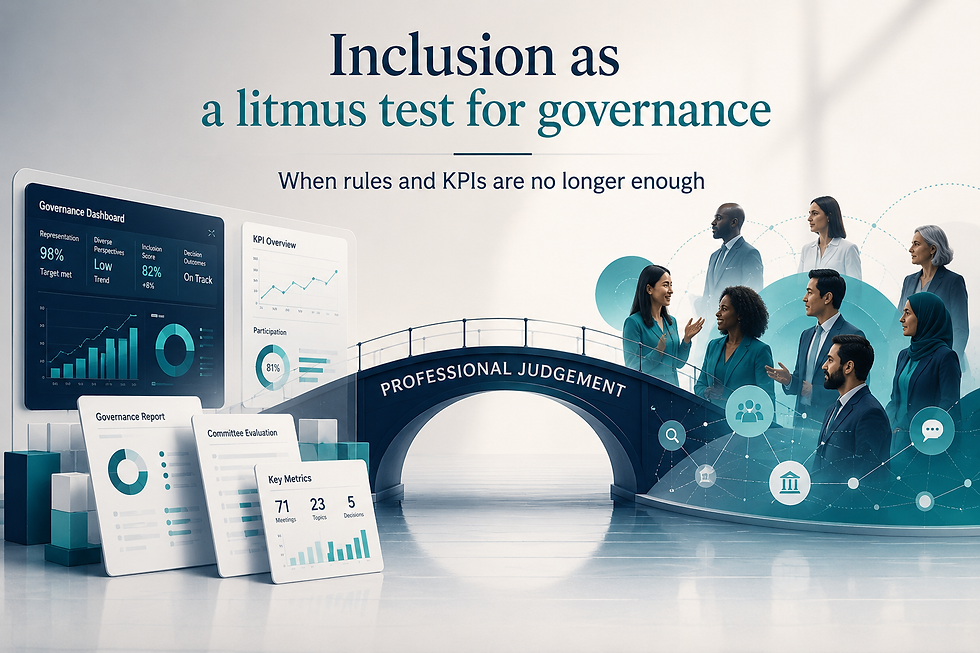
Why inclusion remains a question when rules and KPIs are no longer enough
This is the second article in the series Inclusion as a litmus test for supervision. This article focuses on what inclusion, governance and supervision mean when rules, reports and KPIs are no longer sufficient, and professional judgement becomes decisive. In June 2026, DUFINCO published the first article in this series: Inclusion as a litmus test for supervision. The central point in that article was that inclusion cannot be fully captured in KPIs, reports or business cases.
Indicators can help make developments visible, but they do not tell the whole story. That leads to a follow-up question: why does inclusion remain part of good governance and supervision when regulation provides less direction and external pressure decreases?
That question touches on professional judgement.
More than a compliance issue
Within the CSRD/ESRS framework, organisations determine through the double materiality assessment which sustainability topics are material to them. When diversity and inclusion are identified as a material topic, reporting obligations arise and a more structured approach is expected.
At the same time, outside those formal frameworks, there is increasing room for organisations to make their own choices, for example under voluntary reporting standards such as the VSME.
That has advantages. It creates attention, structure and board-level urgency.
At the same time, there is a risk that inclusion is mainly seen as a topic for which policies must be drafted, indicators must be defined and reports must be prepared. When that happens, attention can easily shift from the underlying governance question to its administrative processing.
The essence of inclusion, however, does not lie in reporting, but in the way organisations deal with differences in perspective, experience and background.
When inclusion is material
Identifying diversity and inclusion as a material topic is the beginning of the conversation, not the end.
When an organisation concludes that the topic is material, it may be expected to reflect this in concrete objectives, programmes, responsibilities, available resources and monitoring.
Not only auditors, but also employees, customers and other stakeholders should be able to understand how the organisation intends to achieve its objectives and which actions are linked to them.
That tension becomes visible when organisations identify diversity and inclusion in their sustainability report as an important or material topic, but then insufficiently translate that choice into policy, resources, responsibilities and board-level priority. This creates the risk that the topic is visible in the report, but insufficiently reflected in actual steering and implementation.
This is precisely where an important supervisory question arises: how can it be established that a material topic is not only reported on, but also genuinely embedded in policy, decision-making and day-to-day practice? The answer does not lie solely in figures and indicators, but also in the choices organisations make, the resources they allocate and the attention that executives and supervisory directors give to the topic.
When inclusion is reported voluntarily or not at all
There is also another situation. Diversity and inclusion may not be identified as material, may only be reported on voluntarily, or may not appear in reporting at all.
In those cases, there may be no formal reporting obligation. But that does not make the governance question disappear.
Even when an organisation does not report on inclusion, it remains relevant how it deals with culture, decision-making, talent development, customer groups and societal alignment.
In fact, precisely when reporting is absent, it becomes visible whether attention to inclusion stems from an external obligation or from a broader view of good governance and supervision.
This is where professional judgement becomes visible. Not because a standard prescribes what must be reported, but because executives and supervisory directors must assess for themselves which topics are important for good governance, careful supervision and sustainable value creation.
Professional judgement requires more than rules
In his work on professional judgement, Iwan Bean emphasises that sustainable professional conduct does not arise solely from rules, control mechanisms or measurable performance. Professionals constantly make assessments in situations where not everything can be defined in advance.
This applies to accountants, lawyers, doctors and supervisors. But it also applies to executives and supervisory directors.
After all, many of the topics they oversee cannot be fully objectified. Consider culture, integrity, leadership, safety or reputation. Indicators may exist for these themes, but ultimately professional judgement remains necessary.
Inclusion belongs to the same category.
The question is not only whether objectives are achieved, but also how decision-making takes place, which perspectives are heard and how organisations deal with differences of insight.
The limits of rules and KPIs
Rules can provide direction. KPIs can make developments visible. Reports can help executives and supervisory directors put topics on the agenda.
But no rule can prescribe how seriously an executive truly listens to dissenting views. No KPI can fully show whether employees feel heard. And no report can guarantee that different perspectives are actually taken into account in decision-making.
That is precisely why professional conduct always has a normative component.
At some point, the question is no longer what regulation prescribes, but what executives, supervisory directors and professionals themselves consider important.
This brings intrinsic motivation into view.
What happens when rules and KPIs are no longer enough?
An interesting test of professional judgement is how organisations act when external pressure decreases.
Does a topic remain important when there is no reporting obligation? When no KPI is measured? When a supervisor does not explicitly ask about it? When economic conditions deteriorate and other priorities emerge?
That is when it becomes visible which topics are truly part of the professional convictions of executives and supervisory directors.
This also applies to inclusion.
If attention to inclusion depends solely on regulation, societal pressure or reputational considerations, there is a risk that the topic will fade into the background as soon as those external incentives decrease.
If, on the other hand, inclusion is part of the professional understanding of good governance and good supervision, it remains relevant — regardless of whether the topic is reported on mandatorily, voluntarily or not at all.
From external obligation to internal conviction
Professional judgement therefore requires more than compliance with rules.
It requires executives and supervisory directors to make their own assessment of which values they consider important for their organisation.
Why do we believe it is important that different perspectives are heard?
Why do we believe it is important that decision-making is not dominated by one way of thinking?
Why do we believe it is important that governance and supervision remain connected to employees, customers and the society in which the organisation operates?
These are not compliance questions.
They are questions of board-level responsibility.
That is why inclusion cannot be legitimised solely on the basis of regulation or a business case. Ultimately, it also comes down to the conviction that careful governance requires openness to different perspectives, critical dissent and societal alignment.
A mirror for professional conduct
The discussion about inclusion is often framed in terms of reporting obligations, objectives or measurable results. These instruments can be useful, but they are not the core of the issue.
Whether inclusion is reported on mandatorily, included voluntarily in reporting or not reported on at all, the same question remains: how does an organisation deal with different perspectives, critical dissent and societal alignment?
In this way, inclusion ultimately becomes a mirror for professional judgement. Not because every outcome is measurable, but because it reveals how organisations deal with responsibility, differences of insight and the quality of their decision-making.
Looking ahead
The next article will focus on the question of who is seen as the right candidate.
Selection procedures often appear objective and neutral, but in practice they are also influenced by existing networks, implicit norms and ideas about suitability. Which experiences, backgrounds and perspectives are taken for granted? And which remain out of view as a result?
Using selection processes in governance and supervision as a starting point, the article will explore how inclusion is not only a matter of representation, but also of societal alignment and the quality of decision-making.
Next month: Who is seen as the right candidate? On selection processes, implicit norms and societal alignment (3/6).
Would you like to discuss the role of inclusion in governance, culture and supervision, or what this means for executive boards and supervisory boards? Please contact us at info@dufinco.nl or call +31 (0)6 512 47 217.
